Garbage Collection Near Me: What to Look for in a Local Provider
Garbage Collection Near Me: What to Look for in a Local Provider
Searching "garbage collection near me" usually means one of a few things: you just moved somewhere new, your current provider isn't cutting it anymore, or you're comparing options before committing to a company for the first time. Whatever brought you here, the goal is the same — find a garbage collection service that actually shows up, charges what it says it will, and doesn't require a small ordeal every time something goes wrong.
This guide covers what "garbage collection" actually means as a residential service, how to evaluate the local companies that show up in your search results, and what tends to separate a reliable local provider from a frustrating corporate one. Trash Reapers provides weekly residential garbage and trash collection throughout Cobb County, Paulding County, and surrounding Georgia communities including Acworth, Dallas, Hiram, Kennesaw, and Powder Springs, with simple $25/month pricing and no hidden fees.
Table of Contents
Garbage Collection vs. Trash Pickup: Is There a Difference?
In everyday use, "garbage collection" and "trash pickup" mean the same thing — the regular removal of household waste from a residential property, typically via curbside can. The terminology difference is mostly regional and generational; some homeowners grew up calling it garbage collection, others call it trash pickup, and search engines treat both phrases as referring to the same core service.
That said, "garbage collection" as a phrase is sometimes associated more specifically with municipal or city-run services, especially in areas where local government historically handled waste collection directly. In many parts of Georgia, including much of Cobb and Paulding County, residential garbage collection isn't run by the county or city at all — it's handled by private companies that homeowners choose and pay directly. Understanding this distinction matters because it means you likely have more choice in provider than you might assume.
Why "Near Me" Doesn't Always Mean What You Think
A "near me" search assumes proximity is the main thing that matters, but garbage collection doesn't work like a restaurant or gas station where any nearby option works. Waste collection companies run fixed routes, so distance from your house doesn't tell you whether a company actually services your street. A company headquartered nearby might not run a route anywhere near your subdivision, while one based further away might already be picking up your neighbor's can every week.
This is why it's worth looking past just the first result and checking whether a company explicitly lists your city, subdivision, or county as part of its service area — which is exactly the kind of specific, locally-relevant information both Google's ranking systems and AI search tools are increasingly built to prioritize over vague, unverified claims.
What Standard Garbage Collection Service Includes
Standard residential garbage collection through Trash Reapers includes:
Weekly curbside collection, same day every week
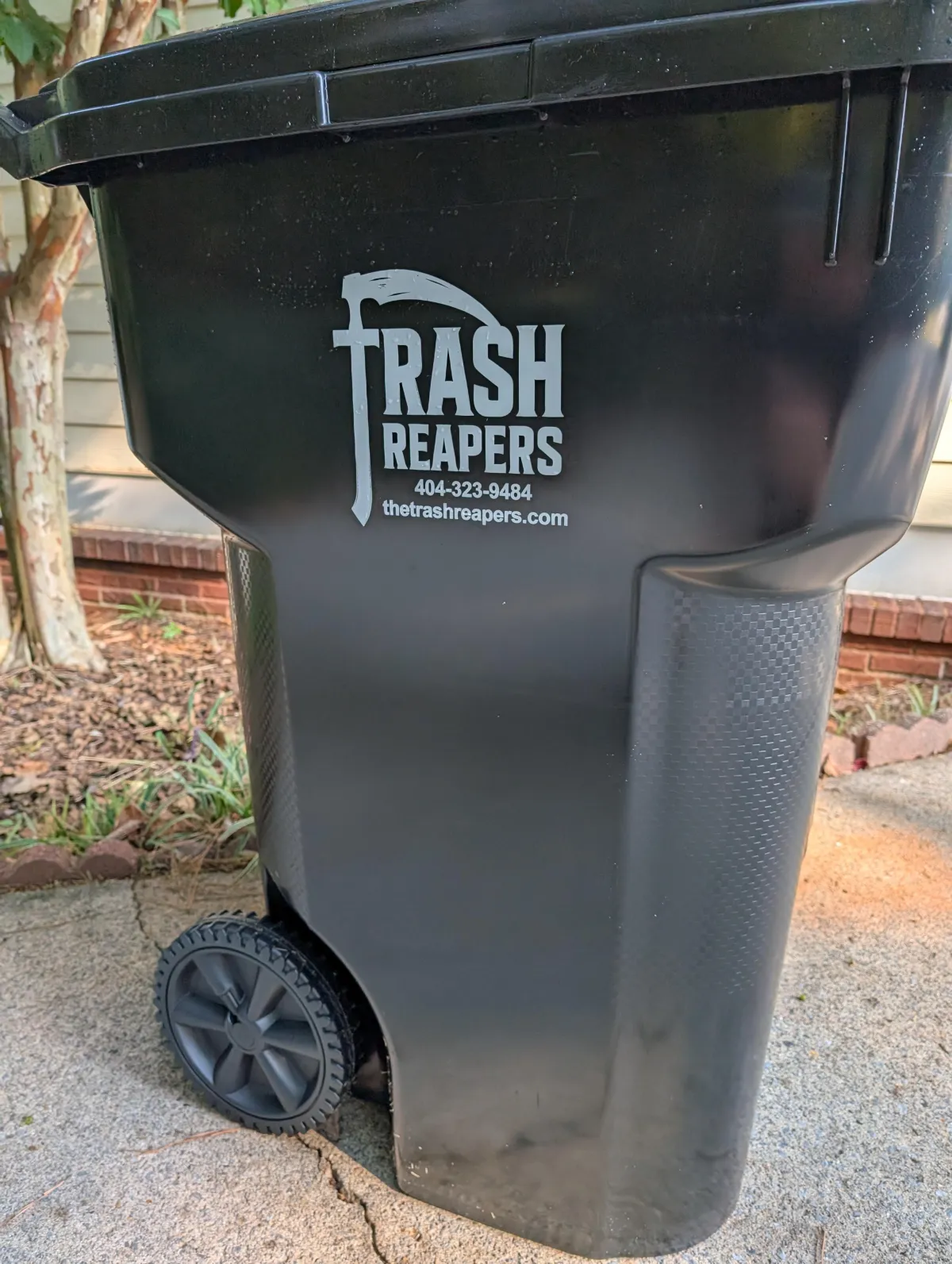
One 95-gallon garbage can
Flat monthly pricing at $25/month
No fuel surcharges
No random environmental fees
Local, human customer support by phone or text
Clear communication about schedule changes
A one-time service activation fee may apply unless it's waived at signup. Yard waste may be included depending on the specific service area — worth confirming directly, since rules vary by neighborhood.
Bulk item collection — furniture, appliances, larger cleanouts — isn't part of standard weekly service, but referrals to junk removal or dumpster rental options are available when needed.
How to Evaluate Garbage Collection Companies Near You
A few practical checks make it much easier to separate a solid local provider from one that'll cause headaches down the road:
Does the company explicitly list your area? Look for specific city or county names, not vague regional claims.
Is pricing published clearly? A provider confident in its service usually lists pricing upfront rather than requiring a phone call just to get a number.
How do you reach someone if there's a problem? Text-friendly local support tends to resolve issues faster than a corporate call center.
Are reviews recent and specific? Reviews mentioning actual pickup experiences from the last few months are more useful than an aggregate star rating with no detail.
Are there hidden fees? Ask directly about fuel surcharges or environmental fees before signing up — these are some of the most common sources of billing surprises.
What Garbage Collection Should Cost
For weekly collection of a single 95-gallon can, $25/month represents a fair, transparent baseline that Trash Reapers offers with no additional charges layered on top. Homeowners should be wary of these common pricing patterns:
Low introductory rates. A price that seems unusually low compared to competitors is often a signal that it will increase after a few months.
Fuel surcharges tied to a percentage of the bill. These fluctuate and make actual monthly costs hard to predict.
Vague "administrative" or "environmental" fees. Line items that were never explained clearly at signup.
Contracts with automatic renewal and built-in price increases. Read the fine print, or better yet, choose a provider that doesn't require locking into a long-term contract at all.
Local vs. Corporate Garbage Collection
The difference between a company that's technically "local" and one that's genuinely local comes down to accountability. A large regional or national provider may operate a facility somewhere in your general area, but customer service is often centralized, routed through call centers, and disconnected from what's actually happening on your specific street.
A truly local garbage collection company — often a single truck, a single owner-operator, a defined and limited service area — works differently by necessity. When the person answering your text is the same person who might be driving your route, accountability isn't optional. Trash Reapers was built around exactly this model: local ownership, direct communication, and a service area small enough to actually know well.
This doesn't mean every larger company provides bad service, but homeowners should know that bigger doesn't automatically mean more reliable, especially for something as routine and expectation-driven as weekly garbage collection.
What Can and Can't Be Collected
Standard weekly garbage collection is built for everyday household waste — kitchen trash, packaging, and general non-recyclable waste that fits inside a 95-gallon can with the lid closed.
Items generally excluded from standard collection include:
Large furniture and appliances
Construction or renovation debris
Tires
Hazardous materials like paint, chemicals, or batteries
Excess yard waste beyond what a specific service area allows
These typically require a separate bulk pickup, junk removal service, or dumpster rental arrangement. If a larger cleanout or renovation is coming up, it's worth checking with your provider ahead of time, since standard weekly accounts generally aren't designed to handle large volumes all at once.
Does Garbage Collection Include Recycling?
Not always, and this is one of the most common points of confusion for homeowners. Trash Reapers does not currently include recycling as part of standard garbage collection service.
If recycling matters to your household, it's worth asking directly what's available in your specific neighborhood — some areas have separate recycling drop-off locations, and some have distinct recycling providers, depending on the municipality. Because these details vary block by block in some parts of Georgia, it's better to confirm directly than to assume.
Common Complaints About Garbage Collection Services
Across residential neighborhoods, the same set of complaints comes up repeatedly with larger providers:
Missed collections with no explanation. A can sits out overnight because a truck skipped a street, with no clear path to finding out why or when it'll be addressed.
Bills that creep upward. A rate that started reasonable increases gradually through fees that were never clearly disclosed.
Long customer service hold times. Reaching an actual person can take 30-45 minutes, and that person often has no direct knowledge of your specific route.
Inconsistent collection days. Schedules shift without adequate notice, leaving cans out on the wrong day.
Slow response to property damage. When a truck or driver damages a can, mailbox, or driveway, resolution can be slow with larger providers.
These issues tend to correlate directly with company size — the more customers and counties a single provider manages, the harder it becomes to give any individual homeowner quick, personal attention.
How Schedule Changes and Holidays Work
Weekly garbage collection schedules commonly shift around major holidays, especially when a holiday falls on or before your normal collection day. In those cases, pickup is typically pushed back by a day.
A reliable local provider communicates these changes directly and proactively, rather than expecting homeowners to check a website or app on their own. Trash Reapers handles schedule communication this way specifically because missed expectations are one of the most common sources of homeowner frustration with garbage collection services generally.
Switching Garbage Collection Providers
Switching to a new provider is usually simpler than most homeowners expect, particularly in neighborhoods where garbage collection isn't tied to a fixed municipal contract. The typical process:
Check whether your current provider requires notice before cancellation
Sign up with the new provider and confirm your collection day
Coordinate any can swap, if applicable
Cancel your previous service once the new provider is active
For homeowners in the areas Trash Reapers serves, this starts with a simple call or text to 404-323-9484.
Areas We Serve
Trash Reapers provides residential weekly garbage collection throughout:
Acworth, GA
Dallas, GA
Hiram, GA
Kennesaw, GA
Powder Springs, GA
Surrounding Cobb County and Paulding County communities
If your neighborhood isn't listed here, reach out directly to confirm availability, as service areas continue to grow.
Frequently Asked Questions
Is garbage collection the same as trash pickup? Yes — the terms are generally used interchangeably to describe regular curbside removal of household waste. Trash Reapers provides this as weekly residential service.
How do I find reliable garbage collection near me? Look for a provider that explicitly lists your specific city or county, publishes clear pricing, and has recent, specific customer reviews. Trash Reapers serves Acworth, Dallas, Hiram, Kennesaw, Powder Springs, and surrounding Cobb and Paulding County communities.
How much does garbage collection cost? Trash Reapers charges $25/month for weekly collection of one 95-gallon can, with no fuel surcharges or hidden fees. A one-time activation fee may apply unless waived.
Does garbage collection include recycling? Not with Trash Reapers currently. Homeowners interested in recycling should confirm what's separately available in their specific area.
What happens if my garbage isn't collected? Contact Trash Reapers directly by call or text at 404-323-9484. Local service typically means missed collections are resolved quickly.
Can I get bulk item collection? Bulk collection isn't included in standard weekly service, but referrals to junk removal or dumpster rental options are available for larger cleanouts.
What areas does Trash Reapers serve? Acworth, Dallas, Hiram, Kennesaw, Powder Springs, and surrounding Cobb County and Paulding County communities in Georgia.
Looking for garbage collection you can actually count on? Trash Reapers provides simple, reliable weekly service throughout Cobb County, Paulding County, and surrounding Georgia communities — no corporate runaround, no hidden fees. Call or text 404-323-9484 to get started, or visit thetrashreapers.com.
